

Getting lab results can feel like trying to read a foreign language. Those numbers, abbreviations, and medical terms might as well be hieroglyphics to most of us. But here’s the thing – you don’t need a medical degree to understand the basics of what your lab results are telling you.
In just five minutes, you can learn to decode the most important parts of your lab report and understand what those numbers actually mean for your health. Let’s break it down step by step.
Meet Medsense for Labs: Understand Your Results in Minutes
If you want a faster, clearer way to make sense of your numbers, Medsense for Labs does the heavy lifting for you. It’s built for people with no medical training and explains results in everyday language.
- User-friendly explanations – We translate medical jargon into plain English and highlight what’s high, low, or normal and what that could mean for you.
- AI-powered insights – Our AI surfaces what matters most in your report, spots patterns across multiple results, and suggests areas for your clinician to focus.
- Trusted health information – Every explanation is grounded in reputable medical sources and links you to further reading from organizations like NIH and CDC.
- Personalized to your report – We use your lab’s own reference ranges and can factor in details like age, sex, and fasting status when provided.
- Clear visuals and trends – Simple charts show changes over time and whether you’re moving toward or away from the normal range.
- Next-step guidance – Get easy pointers on when results are usually rechecked, when to monitor, and when to contact your doctor. No scare tactics, no diagnosis.
- Privacy-first – Your data stays yours. It’s encrypted, and you control what you share.
- Share-ready summaries – Export a clean, one-page summary to bring to your next appointment.
Try Medsense for Labs: https://medsense.me/en/health-information-app/
Note: Medsense provides educational information and is not a substitute for professional medical advice, diagnosis, or treatment.
The Anatomy of a Lab Report
Think of your lab report like a medical passport – it contains all the essential information to identify you and your tests. Every report follows a similar structure, making it easier once you know what to look for.
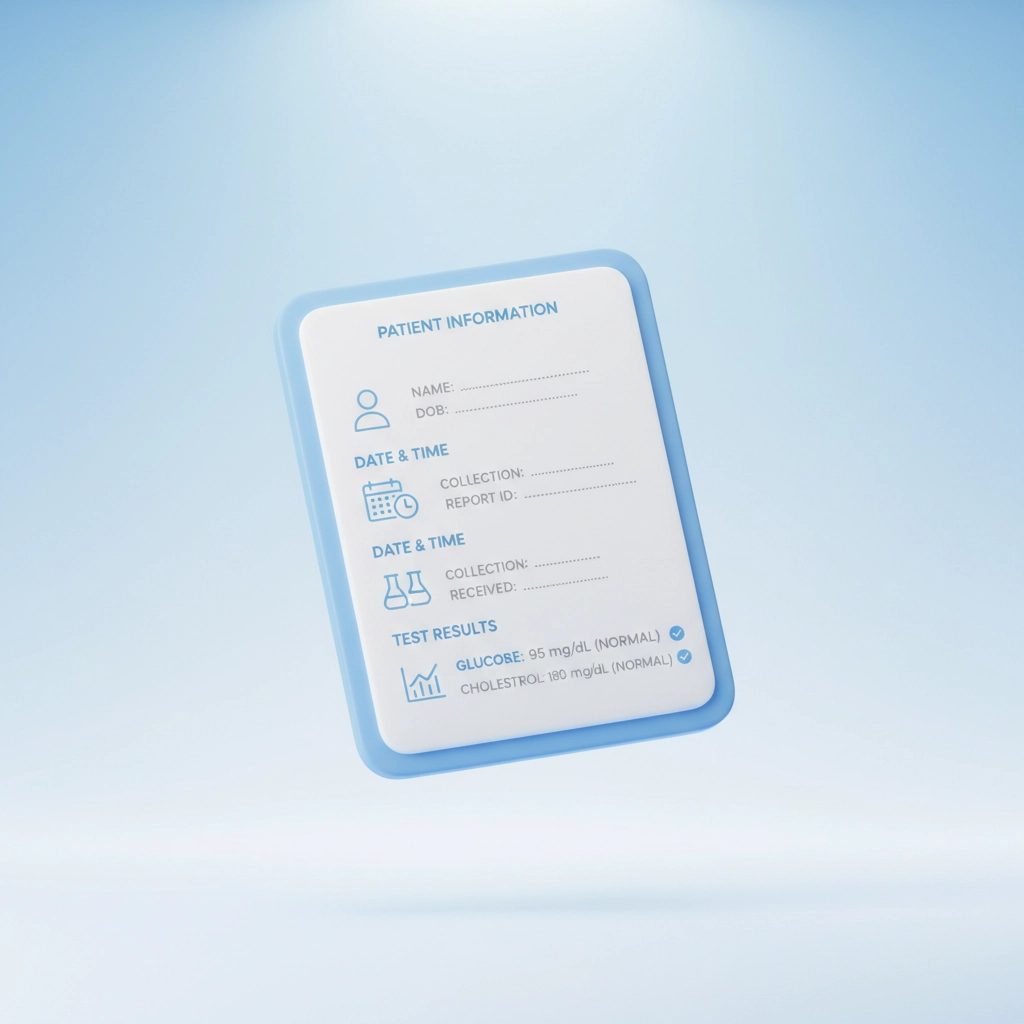
At the top, you’ll find the laboratory’s name and address, along with the date and time your report was printed. This might seem obvious, but it’s important for tracking when results were processed. You’ll also see your personal information, your doctor’s name, and whether your test was marked as “stat” (urgent) or “routine.”
One crucial detail many people overlook is the specimen collection date and time. This tells you exactly when your blood, urine, or other sample was taken. Why does this matter? Because some test results can change throughout the day or be affected by when you last ate or took medication.
Each sample gets a unique laboratory accession number – think of it as a tracking number for your specimen. This ensures your results don’t get mixed up with someone else’s.
Cracking the Code: Common Lab Tests Explained
Complete Blood Count (CBC) – Your Blood’s Report Card
The CBC is like getting a census of your blood cells. It’s one of the most common tests doctors order, and for good reason – it provides a wealth of information about your overall health.
Here’s what the key numbers mean:
White Blood Cells (WBC): Normal range is 5,000-10,000 cells per cubic millimeter (as a general guidance – different labs can have specific reference values). These are your body’s security guards, fighting off infections, foreign invaders and tumor cells. Too high might indicate infection, inflammation or intake of certain medications, while too low could suggest your immune system might be compromised.
Red Blood Cells (RBC): Normal range is 4.2-6.1 million cells per cubic millimeter. These cells carry oxygen into your body and export CO2 out of it. Think of them as tiny transportation trucks managing oxygen and CO2 in every corner of your body.
Hemoglobin (Hgb): Normal range is 12-18 grams per deciliter. This protein inside red blood cells actually carries oxygen and CO2. Low hemoglobin often could give hints on anemia, while high levels might indicate dehydration or other conditions.

Hematocrit (Hct): Normal range is 37-52%. This measures what percentage of your blood is made up of red blood cells. If your blood were a parking lot, hematocrit tells you what percentage is filled with red blood cell “cars.”
Platelets (Plt): Normal range is 150,000-450,000 per cubic millimeter. These tiny cells help your blood clot when you get cut. Too few might mean easy bruising or bleeding, while too many could eventually increase clotting risk but most of the time give hints on current or past unrecognized even mild infection
Basic Metabolic Panel – Your Body’s Chemistry Set
This panel looks at seven key parameters in your blood that reveal how well your kidneys and metabolism [NT1] are working. While the specific tests can vary, they typically include glucose (blood sugar), electrolytes like sodium and potassium, and markers of kidney and liver? function.
Think of this panel as checking your body’s internal chemistry balance – like testing the pH and chemical levels in a swimming pool, but for your bloodstream.
Reading the Numbers: What Those Ranges Really Mean
Reference Ranges – Your Personal Measuring Stick
Next to each result, you’ll see something called a “reference range” or “normal range.” This shows the lowest and highest values considered normal for that particular test and your particular laboratory. Here’s the key thing to remember: these ranges can vary between different laboratories.
Don’t panic if you get tested at two different labs and see slightly different normal ranges. Each lab calibrates their equipment and establishes ranges based on their specific methods and the population they are typically designed to measure.
Platelets (Plt): Normal range is 150,000-450,000 per cubic millimeter. These tiny cells help your blood clot when you get cut. Too few might mean easy bruising or bleeding, while too many could eventually increase clotting risk but most of the time give hints on current or past unrecognized even mild infection
Understanding the Units
Lab results use specific units that might look confusing at first. For example, white blood cell counts are often shown as “x 1,000/mm³” – this means you multiply your result by 1,000 to get the actual number of cells per cubic millimeter.
Red blood cells use “x 1,000,000/mm³” as their unit. So, if your result shows 4.5, your actual red blood cell count is 4.5 million per cubic millimeter. These scientific notations help keep the numbers manageable on the report.
The Flag System
Most labs use a simple flagging system to highlight abnormal results. You’ll typically see:
- H or High for results above the normal range
- L or Low for results below the normal range
- Critical or Panic values for results that need immediate attention
Some labs use symbols like arrows (↑ ↓) or asterisks (*) to mark abnormal values.
Putting It All Together: Smart Interpretation Tips
Timing Is Everything
The collection date and time aren’t just bureaucratic details – they’re crucial for understanding your results set in a time frame. Some tests are sensitive to factors like:
- When you last ate (fasting vs. non-fasting glucose)
- Time of day (cortisol levels change throughout the day)
- Recent exercise or stress
- Medications you’ve taken
- etc.
Test Names and Abbreviations Decoded
Labs love their abbreviations. Here are some common ones you’ll encounter:

CBC: Complete Blood Count
CMP: Comprehensive Metabolic Panel
BMP: Basic Metabolic Panel
TSH: Thyroid Stimulating Hormone
HDL/LDL: Types of cholesterol
BUN: Blood Urea Nitrogen (kidney function)
Cr: Creatinine (another kidney function marker)
When Should You Actually Worry?
Here’s the most important thing to understand: one abnormal result doesn’t necessarily mean you have a serious health problem. Lab values can be affected by many temporary factors:
- Recent illness or infection
- Dehydration
- Medications
- Recent physical activity
- Even stress from the blood draw itself
Red Flags to Watch For:
- Multiple abnormal results in related areas
- Results that are significantly outside the normal range (not just barely high or low)
- Consistent abnormal results over time
- Any result marked as “critical” or requiring immediate attention
The Gray Zone:
Many results fall into what doctors call the “gray zone” – slightly outside normal but not necessarily concerning. These often require follow-up testing or clinical correlation with your symptoms and medical history.
Your Role as an Informed Patient
Understanding your lab results empowers you to have more meaningful conversations with your healthcare provider. You can ask better questions like:

- “My white blood cell count is high – could this be related to the cold I had last week?”
- “I see my glucose is at the high end of normal – should I be concerned about diabetes risk?”
- “What does this trend in my cholesterol levels mean over the past year?”
Remember, lab tests are just one piece of your health puzzle. They work best when interpreted alongside your symptoms, physical exam findings, medical history, and overall clinical picture. Your healthcare provider has the training and experience to put all these pieces toge
Think of lab results as a health snapshot rather than a definitive diagnosis. They provide valuable information, but they need context and professional interpretation to be truly meaningful. By understanding the basics of how to read your results, you become a more informed and engaged patient – and that’s always a good thing for your health.
The key is not to become your own doctor, but rather to be an informed partner in your healthcare journey. With these fundamentals under your belt, those mysterious lab reports will start making a lot more sense.